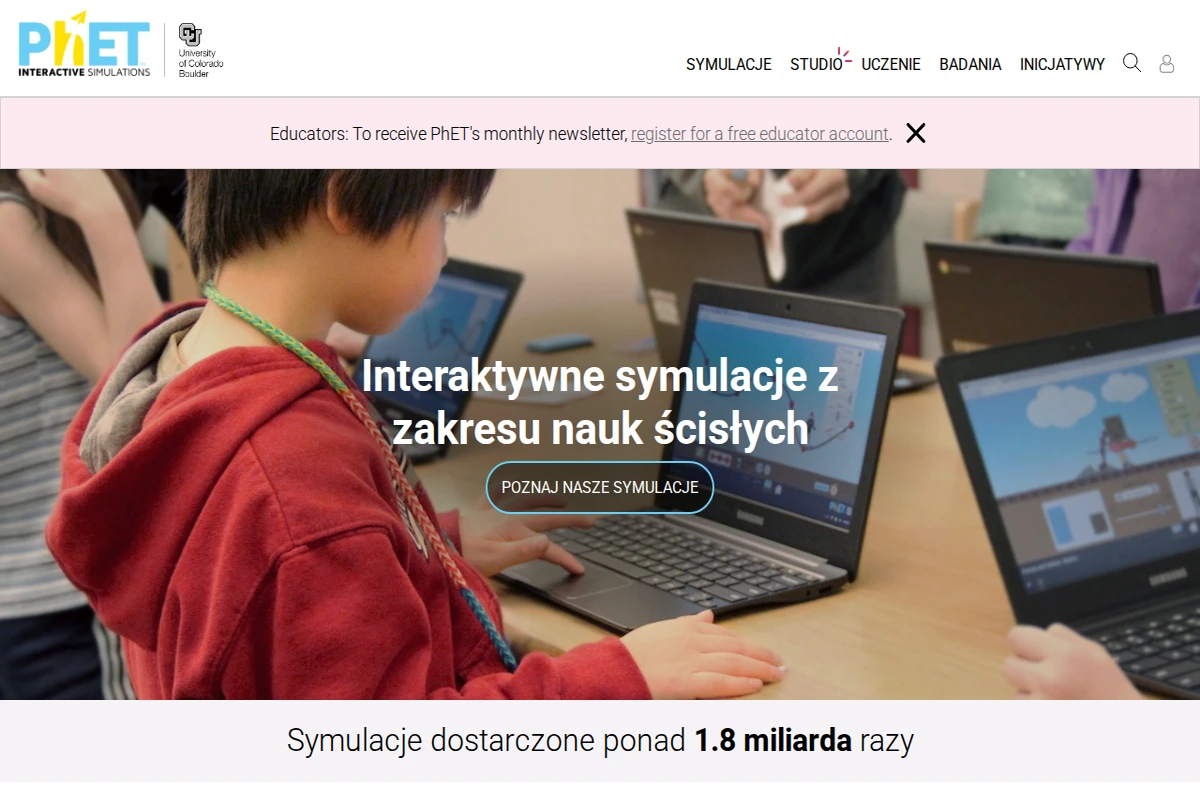
PhET Interactive Simulations is one of the most ambitious and genuinely impactful educational projects on the web. Born in 2002 at the University of Colorado Boulder under the guidance of Nobel Prize-winning physicist Carl Wieman, it set out to answer a deceptively simple question: what if students could play their way into understanding science? Two decades and 1.8 billion simulation runs later, the answer is resoundingly yes.\n\nThe library spans 173 simulations across physics, mathematics and statistics, chemistry, earth science, and biology — all free, all browser-based, and available in 132 languages. Each simulation is built on a foundation of rigorous education research, designed so that learners discover principles through hands-on experimentation rather than passive reading. You can drag electrons around a circuit, watch probability distributions emerge in real time, or manipulate molecules and immediately see how intermolecular forces change. The interface feels closer to a well-designed game than a textbook exercise.\n\nFor educators, PhET goes well beyond just providing tools. The platform hosts over 3,600 teacher-contributed lesson plans, simulation-specific teaching guides, introductory videos, and professional development workshops. A dedicated Studio tier even allows teachers to create customised versions of simulations tailored to specific classroom needs — a rare and thoughtful addition.\n\nWhat makes PhET stand out among educational platforms is its commitment to inclusive design and accessibility. The team actively works on making simulations usable with screen readers and assistive technologies, and the project has a dedicated initiative around diversity, equity, inclusion, and belonging in STEM education. The source code is open, translations are community-driven, and offline access is supported — making PhET genuinely global in reach, not just in aspiration.\n\n🔗 phet.colorado.edu
PhET Interactive Simulations – Free Science & Math Sims