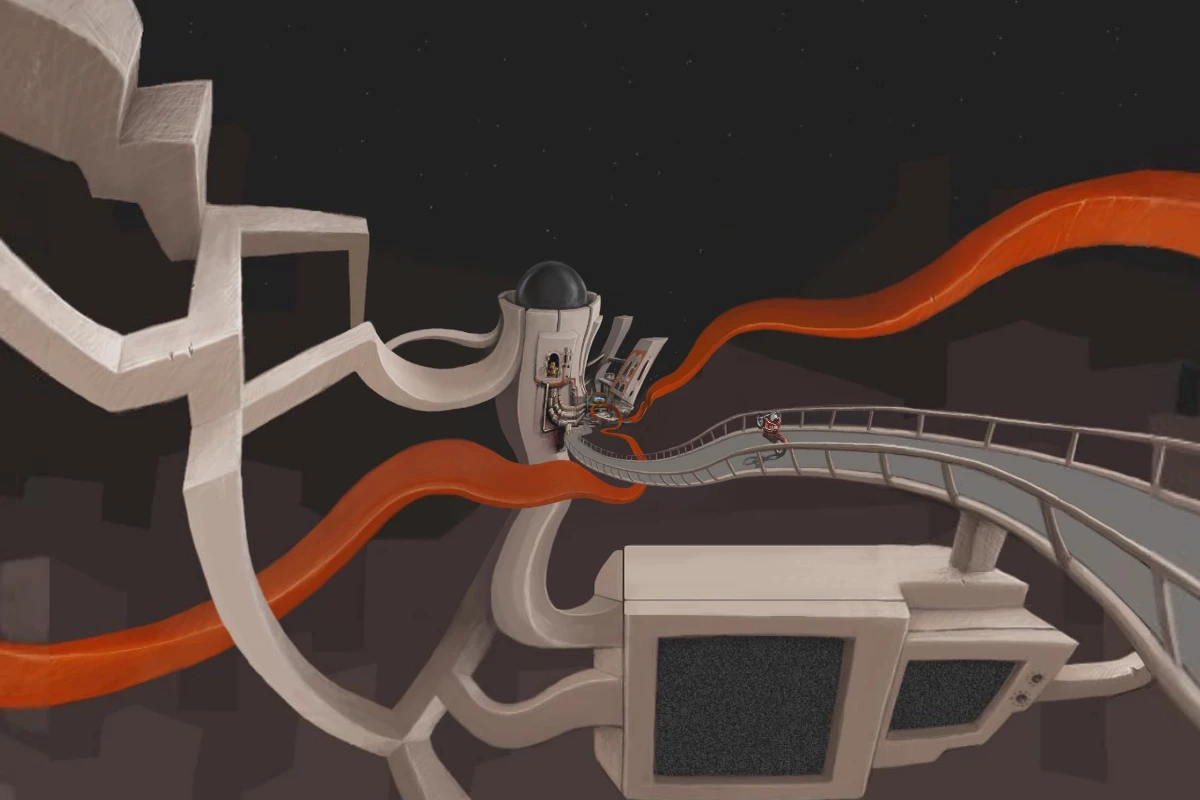
The Zoomquilt stands as one of the internet’s most mesmerizing early digital art experiments, creating an infinite zoom experience that feels both hypnotic and profoundly collaborative. Born in 2004 from the vision of Nikolaus Baumgarten, this project emerged from the early 2000s scene of collaborative online art-making, where artists would contribute individual tiles to evolving patchwork paintings in a process reminiscent of the surrealist drawing game Cadavre Exquis.
The magic lies in its seamless construction: fourteen illustrators each contributed segments that had to blend perfectly with their neighbors’ work, creating visual transitions that flow from one artist’s imagination to another’s. As you navigate with simple up and down arrow keys, you’re taken on a journey through interconnected worlds that range from mechanical and industrial to organic and fantastical. The animation creates the illusion of endless depth, where each zoom level reveals new details and artistic interpretations while maintaining perfect visual continuity.
What makes the Zoomquilt particularly fascinating is how it captures the spirit of early internet collaboration before social media platforms dominated creative expression. The project went viral immediately upon its 2004 release, inspiring sequels like Zoomquilt 2, Arkadia, and Infinite Flowers. It represents a unique moment in digital art history when artists were experimenting with new forms of collective creativity, creating something that feels both nostalgic and timelessly engaging.
The influence of this work extends beyond mere visual spectacle — it demonstrates how digital tools can facilitate genuine artistic collaboration across distances, creating unified experiences from diverse creative voices. The smooth, meditative quality of the infinite zoom invites contemplation while showcasing the unexpected beauty that emerges when artists build upon each other’s work.