A Cloudflare security verification page for biodiversitylibrary.org, showing the site's domain name and a human verification checkbox.

biodiversitylibrary.org

Biodiversity Heritage Library — Natural History Archive

The Biodiversity Heritage Library (BHL) is one of the most ambitious open-access digitization projects ever undertaken in the natural sciences. A consortium of over 500 natural history museums, botanical gardens, research institutions, and libraries worldwide have pooled their rarest and most precious collections to create a single, freely searchable archive of life on Earth — as documented by humans over the past five centuries.\n\nThe sheer scale is staggering: tens of millions of pages of illustrated taxonomic treatises, expedition journals, field guides, and monographs, many of which were previously accessible only to researchers with the means to visit major institutions in person. Here you can leaf through the original editions of works by Linnaeus, Darwin, Audubon, and countless lesser-known naturalists whose careful observations formed the bedrock of modern biology. The illustrations alone — hand-drawn, engraved, and hand-colored plates of plants, insects, birds, and marine creatures — constitute an extraordinary artistic legacy.\n\nBHL is more than a passive repository. Its metadata is deeply interconnected with taxonomic databases, allowing researchers to trace the full bibliographic history of a species name, or discover which expedition first formally described a creature. This makes it an indispensable tool for historians of science, taxonomists, and conservation biologists alike, bridging the gap between centuries-old fieldwork and contemporary biodiversity data.\n\nFor the curious non-specialist, BHL is simply a treasure trove of wonder — a place to lose hours browsing gorgeously illustrated Victorian-era botanical atlases or the handwritten field notes of 18th-century explorers. Few places on the internet offer such a direct, tactile connection to the long human project of naming and understanding the living world.\n\n🔗 biodiversitylibrary.org ...
July 18, 2026 · Cogimator Team
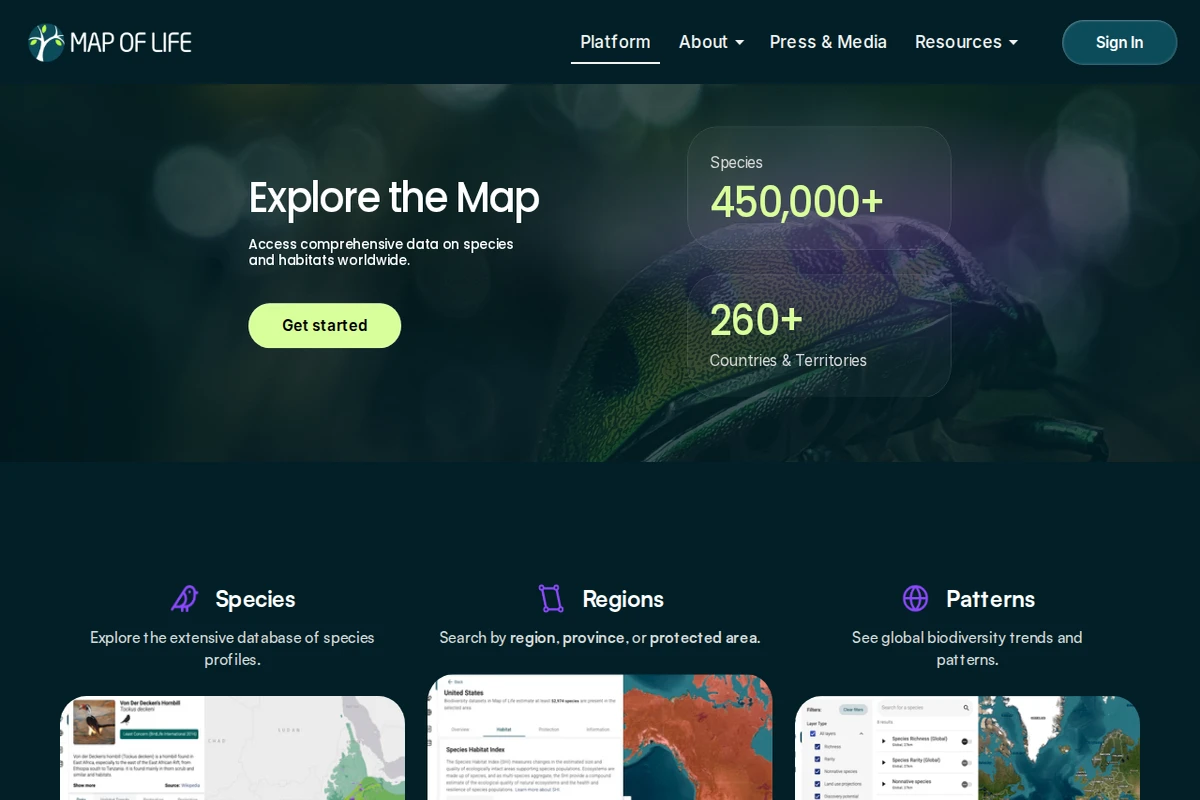
The Map of Life homepage showing a dark hero section with a chameleon close-up, species count of 450,000+, and navigation options for Species, Regions, and Patterns.

mol.org

Map of Life — Global Biodiversity Atlas

Map of Life is one of the most ambitious biodiversity data platforms on the web — a living atlas that attempts to answer a deceptively simple question: what lives where? With over 450,000 species catalogued across more than 260 countries and territories, it draws on decades of scientific research to make the distribution of life on Earth explorable by anyone with a browser.\n\nThe platform is organized around three core lenses. Through Species, users can browse detailed profiles for animals, plants, fungi, and more, each tied to geographic range data and sourced imagery. Through Regions, you can zoom into any country, province, or protected area and immediately see what species call it home, along with habitat quality metrics. The Patterns view steps back to reveal global biodiversity trends — where richness is concentrating, where it’s declining, and how ecosystems are shifting over time.\n\nWhat sets Map of Life apart from a simple species database is its role in actual conservation policy. Its Species Protection Index, Species Habitat Index, and Species Information Index have been formally adopted under the Kunming-Montreal Global Biodiversity Framework (GBF) — meaning the numbers generated here feed directly into international targets for nature protection. That’s a rare thing: a website whose outputs matter in diplomatic negotiating rooms.\n\nThe design is clean and map-centric, prioritizing exploration over information overload. Whether you’re a researcher tracking population changes, a curious naturalist wondering what beetles inhabit your province, or a policymaker needing hard indicators, Map of Life meets you where you are. It’s science made navigable — and the stakes behind it couldn’t be higher.\n\n🔗 mol.org ...

July 18, 2026 · Cogimator Team
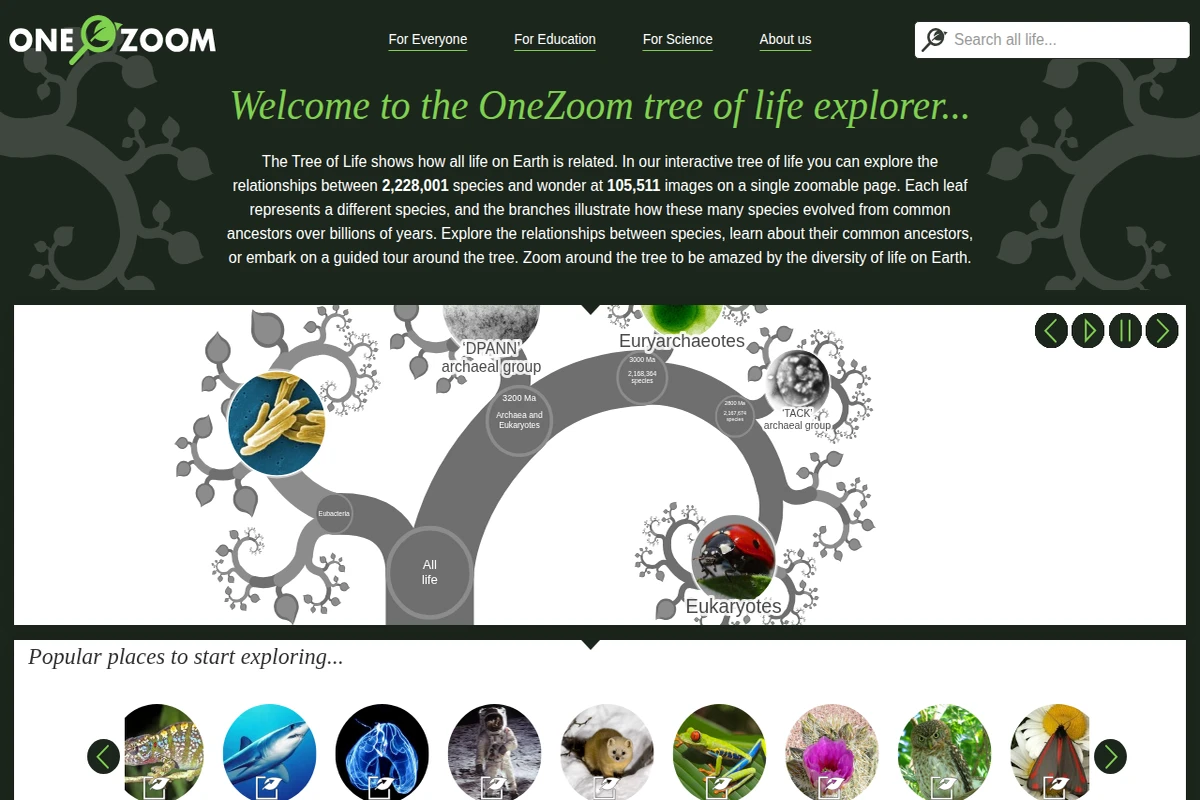
The OneZoom homepage showing a fractal tree of life visualization with labeled clades including Eukaryotes, Archaea, and Eubacteria on a dark background.

onezoom.org

OneZoom — Interactive Tree of Life Explorer

OneZoom does something genuinely extraordinary: it fits the entire known tree of life onto a single, infinitely zoomable page. With over 2,228,001 species represented as leaves and more than 105,000 photographs embedded directly into the visualization, the experience of navigating it feels less like browsing a database and more like flying through a living, branching universe. The fractal structure is not just aesthetic — it mirrors the actual logic of evolution, with branch lengths corresponding to geological time and divergence points labeled in millions of years.\n\nWhat sets OneZoom apart from typical biology resources is its sheer navigability. You can leap from humans to grey wolves to hummingbirds to hard corals, tracing shared ancestry along the way, or follow a guided tour through a particular group. The interface is intuitive enough for a curious 13-year-old and rigorous enough to earn endorsements from Richard Dawkins and Dame Georgina Mace. It genuinely bridges the gap between popular science and serious phylogenetics.\n\nThe project is run as a registered UK non-profit, which explains the absence of ads and the open ethos. Sections tailored for educators, museum installers, and researchers make it unusually versatile — it has appeared as large-format interactive installations and as an embeddable widget for scientific publications. A public API and a “popularity index” for species round out the toolkit for anyone wanting to go deeper.\n\nSponoring a leaf — literally having your name appear on a species in the tree — is a charming fundraising mechanic that also functions as a quiet meditation on scale: your name, alongside 2.2 million others. OneZoom is one of those rare websites that manages to make the abstract enormity of life on Earth feel personal and explorable.\n\n🔗 onezoom.org ...

July 18, 2026 · Cogimator Team
Aerial satellite view of a forested coastline with the Global Forest Watch interface overlay showing forest monitoring tools and navigation menu.

globalforestwatch.org

Global Forest Watch - Real-Time Forest Monitoring Platform

Global Forest Watch represents one of the most sophisticated and democratically accessible forest monitoring systems ever created. This World Resources Institute initiative transforms satellite data into actionable intelligence, offering real-time deforestation alerts that can detect illegal logging and forest destruction within days of occurrence. The platform’s strength lies in its comprehensive approach to forest monitoring. The GLAD alerts system provides weekly updates on tropical deforestation, while interactive dashboards allow users to analyze forest change trends anywhere on Earth with just a few clicks. From tracking illegal gold mining in the Amazon to monitoring palm oil supply chains for corporate compliance, the platform serves diverse stakeholders from conservation organizations to multinational corporations. ...

May 7, 2026 · Cogimator Team