A Cloudflare security verification page for biodiversitylibrary.org, showing the site's domain name and a human verification checkbox.

biodiversitylibrary.org

Biodiversity Heritage Library — Natural History Archive

The Biodiversity Heritage Library (BHL) is one of the most ambitious open-access digitization projects ever undertaken in the natural sciences. A consortium of over 500 natural history museums, botanical gardens, research institutions, and libraries worldwide have pooled their rarest and most precious collections to create a single, freely searchable archive of life on Earth — as documented by humans over the past five centuries.\n\nThe sheer scale is staggering: tens of millions of pages of illustrated taxonomic treatises, expedition journals, field guides, and monographs, many of which were previously accessible only to researchers with the means to visit major institutions in person. Here you can leaf through the original editions of works by Linnaeus, Darwin, Audubon, and countless lesser-known naturalists whose careful observations formed the bedrock of modern biology. The illustrations alone — hand-drawn, engraved, and hand-colored plates of plants, insects, birds, and marine creatures — constitute an extraordinary artistic legacy.\n\nBHL is more than a passive repository. Its metadata is deeply interconnected with taxonomic databases, allowing researchers to trace the full bibliographic history of a species name, or discover which expedition first formally described a creature. This makes it an indispensable tool for historians of science, taxonomists, and conservation biologists alike, bridging the gap between centuries-old fieldwork and contemporary biodiversity data.\n\nFor the curious non-specialist, BHL is simply a treasure trove of wonder — a place to lose hours browsing gorgeously illustrated Victorian-era botanical atlases or the handwritten field notes of 18th-century explorers. Few places on the internet offer such a direct, tactile connection to the long human project of naming and understanding the living world.\n\n🔗 biodiversitylibrary.org ...

July 18, 2026 · Cogimator Team
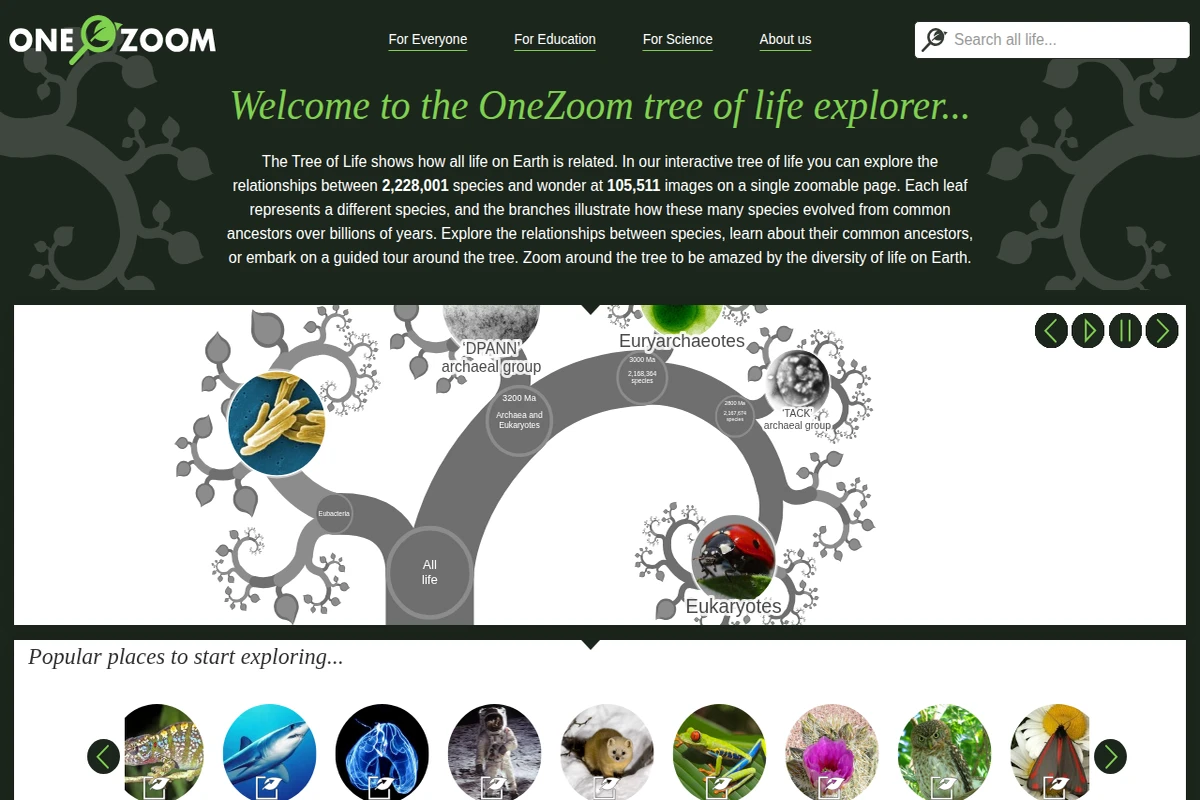
The OneZoom homepage showing a fractal tree of life visualization with labeled clades including Eukaryotes, Archaea, and Eubacteria on a dark background.

onezoom.org

OneZoom — Interactive Tree of Life Explorer

OneZoom does something genuinely extraordinary: it fits the entire known tree of life onto a single, infinitely zoomable page. With over 2,228,001 species represented as leaves and more than 105,000 photographs embedded directly into the visualization, the experience of navigating it feels less like browsing a database and more like flying through a living, branching universe. The fractal structure is not just aesthetic — it mirrors the actual logic of evolution, with branch lengths corresponding to geological time and divergence points labeled in millions of years.\n\nWhat sets OneZoom apart from typical biology resources is its sheer navigability. You can leap from humans to grey wolves to hummingbirds to hard corals, tracing shared ancestry along the way, or follow a guided tour through a particular group. The interface is intuitive enough for a curious 13-year-old and rigorous enough to earn endorsements from Richard Dawkins and Dame Georgina Mace. It genuinely bridges the gap between popular science and serious phylogenetics.\n\nThe project is run as a registered UK non-profit, which explains the absence of ads and the open ethos. Sections tailored for educators, museum installers, and researchers make it unusually versatile — it has appeared as large-format interactive installations and as an embeddable widget for scientific publications. A public API and a “popularity index” for species round out the toolkit for anyone wanting to go deeper.\n\nSponoring a leaf — literally having your name appear on a species in the tree — is a charming fundraising mechanic that also functions as a quiet meditation on scale: your name, alongside 2.2 million others. OneZoom is one of those rare websites that manages to make the abstract enormity of life on Earth feel personal and explorable.\n\n🔗 onezoom.org ...

July 18, 2026 · Cogimator Team
A child using a laptop in a classroom with PhET interactive science simulations visible on screen.

phet.colorado.edu/pl

PhET Interactive Simulations – Free Science & Math Sims

PhET Interactive Simulations is one of the most ambitious and genuinely impactful educational projects on the web. Born in 2002 at the University of Colorado Boulder under the guidance of Nobel Prize-winning physicist Carl Wieman, it set out to answer a deceptively simple question: what if students could play their way into understanding science? Two decades and 1.8 billion simulation runs later, the answer is resoundingly yes.\n\nThe library spans 173 simulations across physics, mathematics and statistics, chemistry, earth science, and biology — all free, all browser-based, and available in 132 languages. Each simulation is built on a foundation of rigorous education research, designed so that learners discover principles through hands-on experimentation rather than passive reading. You can drag electrons around a circuit, watch probability distributions emerge in real time, or manipulate molecules and immediately see how intermolecular forces change. The interface feels closer to a well-designed game than a textbook exercise.\n\nFor educators, PhET goes well beyond just providing tools. The platform hosts over 3,600 teacher-contributed lesson plans, simulation-specific teaching guides, introductory videos, and professional development workshops. A dedicated Studio tier even allows teachers to create customised versions of simulations tailored to specific classroom needs — a rare and thoughtful addition.\n\nWhat makes PhET stand out among educational platforms is its commitment to inclusive design and accessibility. The team actively works on making simulations usable with screen readers and assistive technologies, and the project has a dedicated initiative around diversity, equity, inclusion, and belonging in STEM education. The source code is open, translations are community-driven, and offline access is supported — making PhET genuinely global in reach, not just in aspiration.\n\n🔗 phet.colorado.edu ...

July 18, 2026 · Cogimator Team
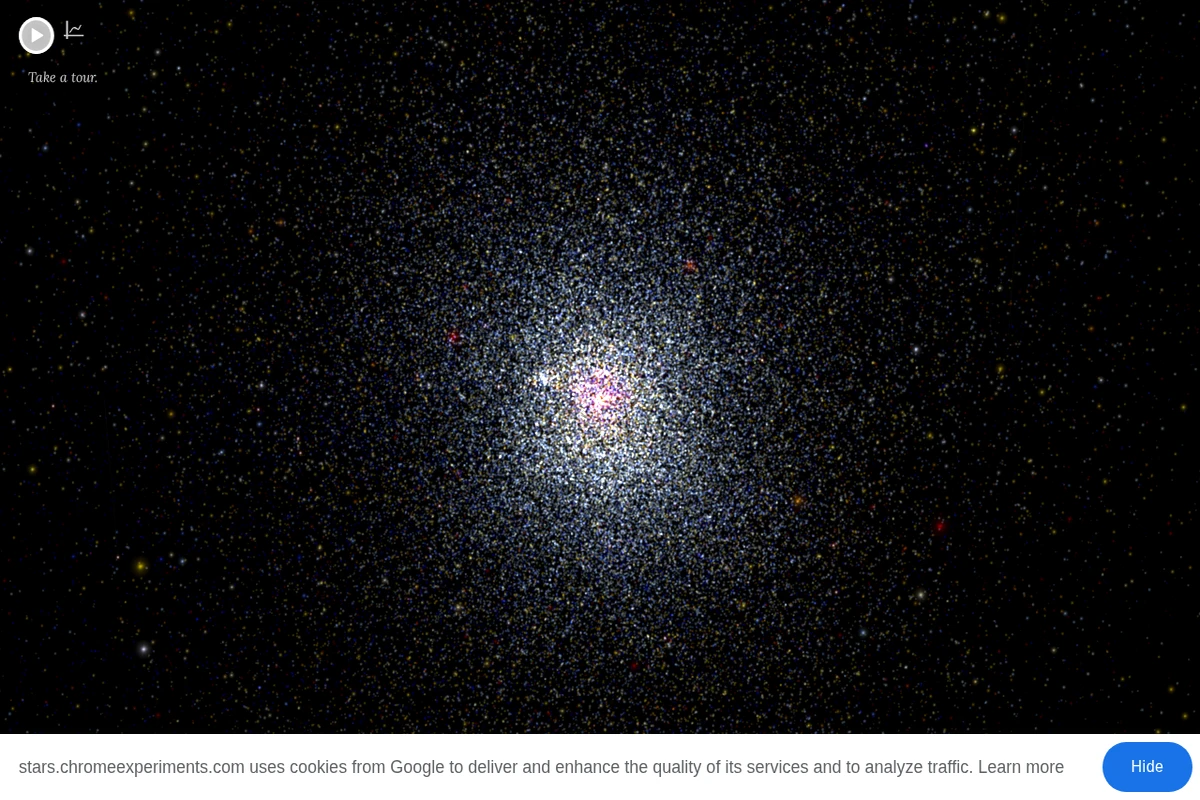
A 3D visualization showing thousands of stars as colorful points against a black space background with navigation controls.

stars.chromeexperiments.com

Interactive 3D Star Map by Chrome Experiments

This remarkable Chrome Experiment transforms astronomical data into a breathtaking interactive journey through our cosmic neighborhood. The visualization presents thousands of stars positioned according to their actual three-dimensional coordinates in space, allowing visitors to navigate freely through the stellar landscape surrounding our solar system. What makes this experience particularly compelling is its scientific accuracy combined with intuitive exploration. Each star is positioned based on real astronomical data, including familiar names like Proxima Centauri, Sirius, Vega, and Betelgeuse. The interface encourages discovery through movement, letting you appreciate the true scale and structure of our local stellar environment in ways that traditional flat star charts simply cannot convey. ...

May 30, 2026 · Cogimator Team
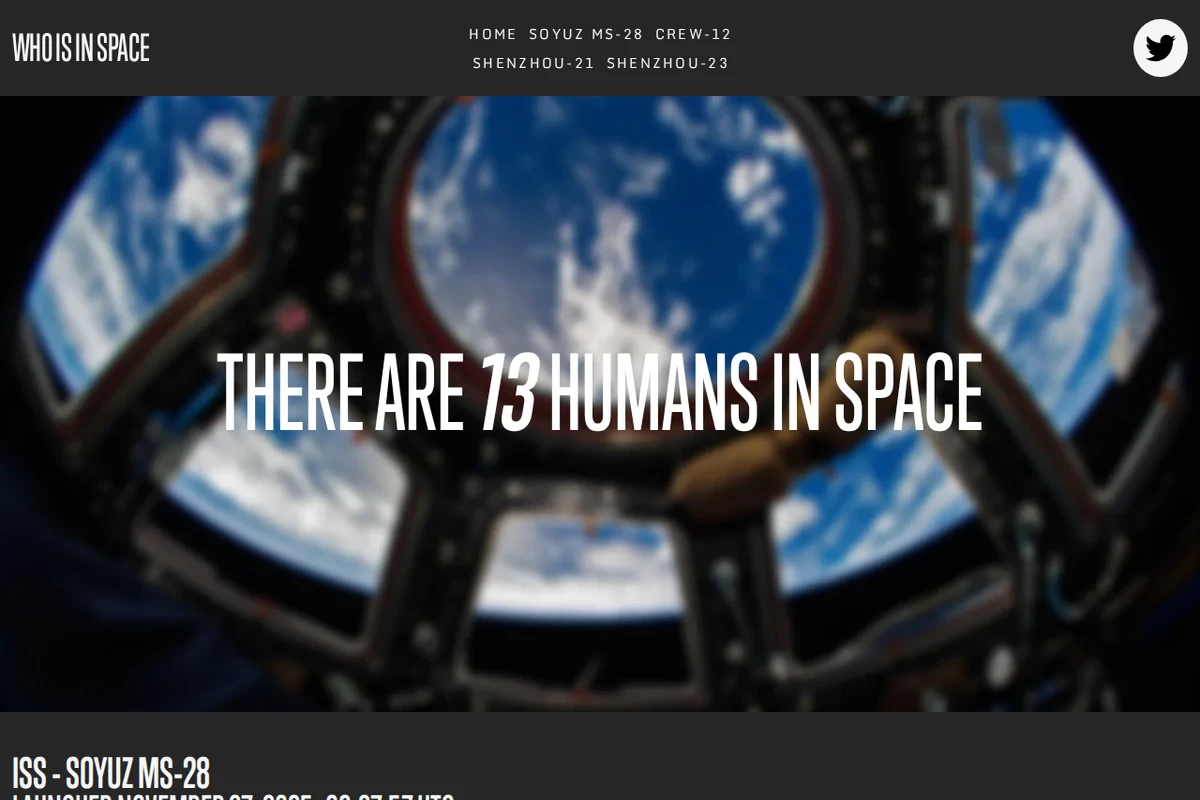
Website showing a space station view with Earth visible through windows and text stating 'There are 13 humans in space'.

whoisinspace.com

Who Is in Space - Live Astronaut Tracker

In an era where space travel is becoming increasingly routine, Who Is in Space serves as our celestial attendance sheet, tracking every human currently beyond Earth’s atmosphere. This elegantly simple website provides real-time information about astronauts and cosmonauts aboard the International Space Station, China’s Tiangong station, and other orbital outposts. Created by Destin Sandlin of the popular science YouTube channel Smarter Every Day, the site presents mission details with precision timing down to the second. Each crew member’s profile includes their current mission duration and total accumulated time in space, offering fascinating insights into the dedication required for space exploration. The clean interface displays launch dates, mission codes, and crew rotations across multiple space agencies. ...

May 30, 2026 · Cogimator Team
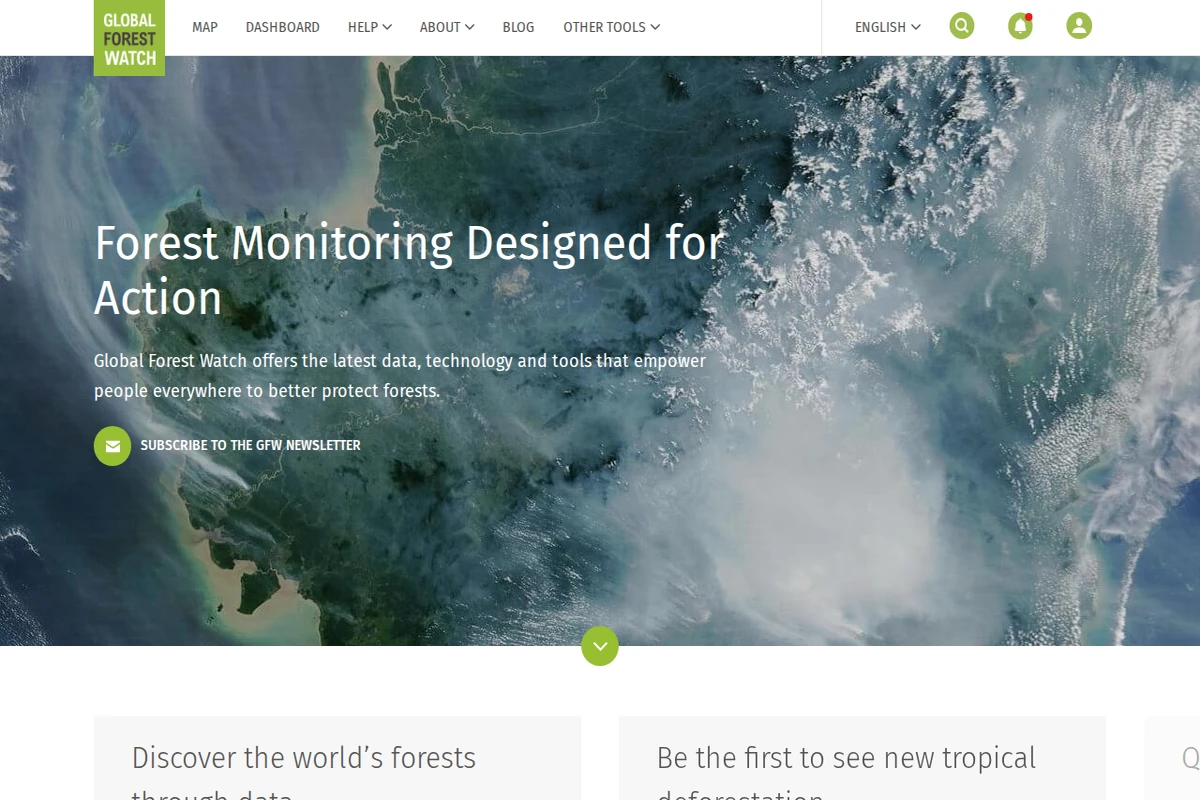
Aerial satellite view of a forested coastline with the Global Forest Watch interface overlay showing forest monitoring tools and navigation menu.

globalforestwatch.org

Global Forest Watch - Real-Time Forest Monitoring Platform

Global Forest Watch represents one of the most sophisticated and democratically accessible forest monitoring systems ever created. This World Resources Institute initiative transforms satellite data into actionable intelligence, offering real-time deforestation alerts that can detect illegal logging and forest destruction within days of occurrence. The platform’s strength lies in its comprehensive approach to forest monitoring. The GLAD alerts system provides weekly updates on tropical deforestation, while interactive dashboards allow users to analyze forest change trends anywhere on Earth with just a few clicks. From tracking illegal gold mining in the Amazon to monitoring palm oil supply chains for corporate compliance, the platform serves diverse stakeholders from conservation organizations to multinational corporations. ...

May 7, 2026 · Cogimator Team
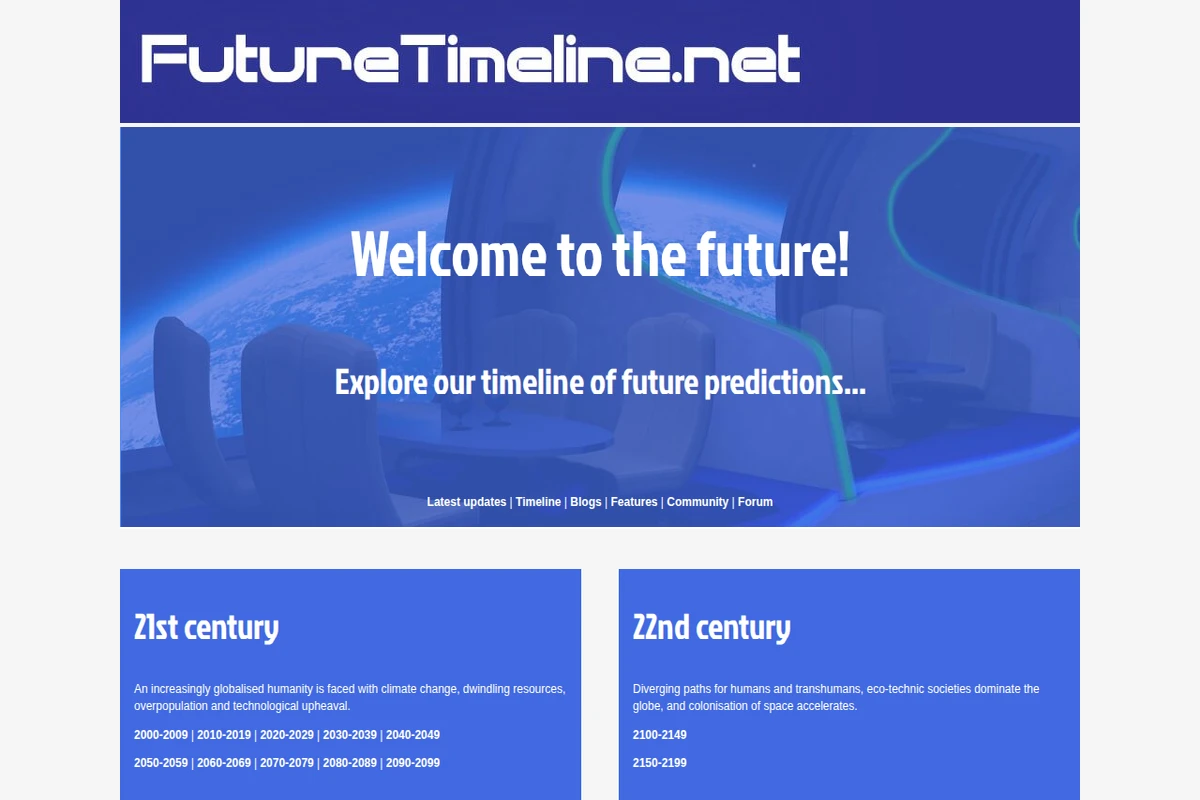
The Future Timeline website homepage showing a blue space-themed design with navigation options for different centuries and time periods.

futuretimeline.net

Future Timeline - Interactive Predictions Through the Centuries

Future Timeline presents one of the most comprehensive attempts to map humanity’s long-term future, stretching from our current century through to cosmic scales of time. This remarkable resource organizes predictions and speculations across multiple disciplines, from climate science and artificial intelligence to space colonization and the ultimate fate of consciousness itself. The site’s structure is elegantly chronological, beginning with the challenges of our globalized 21st century—climate change, resource depletion, and technological upheaval—before expanding into increasingly speculative territory. The 22nd century explores diverging paths for humans and transhumans, while the far future contemplates post-biological humanity spreading throughout the galaxy. What sets this project apart is its serious engagement with both near-term scientific consensus and far-future theoretical possibilities. ...

April 16, 2026 · Cogimator Team
A colorful fluid simulation showing swirling patterns of blue, red, yellow, and green colors mixing together like liquid paint.

paveldogreat.github.io/WebGL-Fluid-Simulation

WebGL Fluid Simulation - Interactive Physics Playground

This stunning WebGL fluid simulation transforms your browser into a physics playground where every mouse movement creates ripples of liquid color. Developed by Pavel Dobryakov, the simulation demonstrates sophisticated computational fluid dynamics running entirely in real-time through WebGL shaders. The interface offers remarkable control over the physics parameters — adjust density diffusion to make colors blend more smoothly, crank up vorticity for more turbulent swirls, or modify pressure settings to change how the fluid responds to disturbances. The visual effects are equally impressive, with optional bloom lighting and sunray effects that make the flowing colors appear almost luminescent against the dark canvas. ...

April 16, 2026 · Cogimator Team
Screenshot of Orb.Farm showing a pixelated aquatic ecosystem with a pink and purple spiral organism, various interface elements for adding materials and creatures, and environmental controls.

orb.farm

Orb.Farm - Digital Aquatic Ecosystem Simulator

Orb.Farm presents a delightfully pixelated take on ecosystem simulation, inviting users to cultivate their own miniature aquatic worlds within a web browser. This charming digital terrarium combines the meditative qualities of fishkeeping with the experimental joy of building balanced ecosystems from scratch. The interface reveals itself as both intuitive and surprisingly deep, offering an array of biological and environmental elements to experiment with. Users can introduce fish, algae, bacteria, and daphnia into their virtual aquariums, then observe how these organisms interact, compete, and coexist. The addition of physical materials like sand, glass, wood, and stone allows for creative habitat design, while environmental controls for oxygen and CO2 levels add scientific depth to the experience. ...

April 13, 2026 · Cogimator Team
Screenshot of OpenTopography website showing a hillshade visualization of Yaquina Head, Oregon with navigation menu and latest news section.

opentopography.org

OpenTopography - High-Resolution Topographic Data and Tools

OpenTopography represents a remarkable achievement in democratizing access to high-resolution topographic data. This NSF-supported platform serves as a centralized hub where researchers, educators, and professionals can easily discover and access diverse collections of terrain data, including lidar point clouds, radar datasets, and digital elevation models from sources like the USGS 3D Elevation Program. What sets OpenTopography apart is its commitment to simplifying the traditionally complex world of geospatial data. The platform integrates datasets covering over 500,000 km² globally, offering both web-based point-and-click access for casual users and sophisticated programmatic tools for researchers building automated workflows. The site features everything from detailed hillshade visualizations of Oregon’s coastline to 3D point cloud data of Colorado’s Flatirons, making complex topographic information accessible to a broad audience. ...

April 8, 2026 · Cogimator Team